
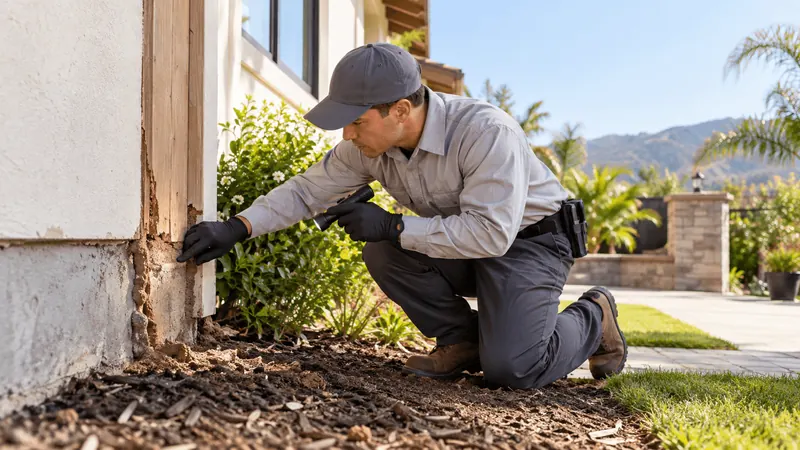
Two Kinds of Termites Damage Oxnard Homes
Coastal Southern California has both main types, and they are treated differently.
- Drywood termites live inside the wood they eat and don't need contact with soil. They show up in attic framing, window and door frames, eaves, fascia boards, wood siding and furniture. Each colony is fairly small, but one house can have several.
- Subterranean termites nest in the soil and travel up into the house through mud tubes or cracks in the slab. They need moisture, so they go for wood near the ground, sill plates, damp sub-floors and areas around leaking plumbing.
Signs of Termites in Your House
Termites rarely show themselves. These are the signs homeowners actually find:
- Pellet piles. Small, hard, sand-like pellets collecting on windowsills, the floor under a door frame, or on stored items in the attic or garage. This is the most common sign of drywood termites.
- Tiny round holes in wood, sometimes patched with a brownish plug. Drywood termites use these to push pellets out.
- Discarded wings on windowsills, in spider webs or near light fixtures after a swarm.
- Swarmers. Winged termites flying out of a wall, window frame or ceiling, often on warm days after rain.
- Mud tubes about the width of a pencil running up the foundation, stem wall, garage slab edge or pier posts in a crawlspace. This points to subterranean termites.
- Wood that sounds hollow or gives way when pressed, blistered paint on trim, or baseboards that crumble.
What a Termite Inspection Involves
The inspection starts with the areas where you found signs, then covers the rest of the structure. The technician checks accessible attic framing, eaves and fascia, window and door frames, the garage, the exterior wood, and the foundation. On raised-foundation houses that means going into the crawlspace and checking sill plates, joists, piers and plumbing penetrations. On slab houses it means checking the slab edge, expansion joints and bath traps.
Along with active termites, the inspection notes conditions that invite them: wood touching soil, leaking plumbing, poor sub-floor ventilation, firewood stacked against the house and earth piled above the weep screed. You get an explanation of what was found and where.
If you are buying or selling a house, lenders and buyers often ask for a Wood Destroying Pests and Organisms (WDO) inspection report during escrow. Tell us when you call if the inspection is for a sale.
Termite Treatment Options
Localized treatment for drywood termites
When drywood termite activity is limited to areas we can reach, we treat the infested wood directly. That usually means drilling small holes into the galleries and injecting a termiticide or foam, then sealing the holes. It is done without vacating the house, and it works well when the problem is caught early in a few boards.
Whole-structure fumigation
When termites are in several parts of the house, inside walls or in wood that can't be opened up, a localized treatment can miss colonies. Whole-structure fumigation (tenting) fills the entire building with a gas that reaches every piece of wood. It requires the household, pets and plants to leave for about two to three days and food and medicine to be bagged. If the inspection points to fumigation, we explain why and walk you through the preparation.
Subterranean termite treatment
Subterranean termites are treated at the soil. A liquid termiticide is applied to the soil along the foundation and at points where the termites are entering, sometimes by drilling through the slab or patio. Bait stations placed around the house are another option. Fixing the moisture source, such as a leaking pipe or poor drainage, is part of the job.
Damaged wood
Treatment stops termites; it doesn't replace wood they have already eaten. Badly damaged trim, fascia or framing may need a carpenter or contractor to replace it after treatment.
What Affects the Cost of Termite Treatment
Termite treatment cost depends mostly on how widespread the activity is and which treatment it calls for. Localized drywood treatment is priced by the number of areas treated and how hard they are to reach. Fumigation is priced by the size and shape of the building. Subterranean treatment is priced by the linear feet of foundation treated and whether drilling through concrete is needed.
Other things that change the price: finished attics or walls that need to be opened, tile roofs and tall two-story walls that make tenting harder, crawlspaces with low clearance, and any repair of damaged wood. We give you the price after the inspection.
When Termites Need Urgent Attention
Termites rarely create a same-day emergency, but some situations shouldn't wait:
- A swarm of winged termites coming out of a wall or ceiling inside the house
- Wood that is soft or crumbling in a structural area, such as a floor joist, beam, stair or deck support
- Termite activity found during escrow with a closing date coming up
- Mud tubes near a leak in the crawlspace, where moisture is feeding an active colony
If a floor, deck or stair feels unsafe to walk on, keep people off it until it has been checked.
Why Termites Are a Constant Issue Near the Oxnard Coast
Oxnard's mild coastal climate is good for drywood termites. There is no freezing winter to slow them down, so colonies stay active and swarmers can come out from late summer through fall. At the same time, the marine layer keeps humidity high near the coast, which keeps sub-floors, crawlspaces and exterior wood on older beach and harbor homes damp. Damp wood is easier for subterranean termites to attack and also grows wood decay fungus. For homeowners in areas like Oxnard Shores, Silver Strand and Marina West, with more exposed wood and raised foundations, a termite inspection every few years catches activity before it reaches the framing.
How to Prepare for a Termite Inspection
- Clear access to the attic hatch, crawlspace entry, garage walls and under sinks.
- Don't sweep up pellet piles or wings before the visit. They help us identify the species and where it is active.
- Note where and when you saw swarmers.
- Move items stacked against exterior walls so the foundation can be seen.
After Termite Treatment: What to Watch For
After localized drywood treatment, sweep up the old pellets and check the same spots over the next several weeks. New pellets in a cleaned spot mean the colony is still active and needs to be rechecked. After subterranean treatment, watch for new mud tubes and fix any leaks or drainage problems we pointed out. Keeping soil, mulch and firewood away from wood siding and below the weep screed makes a difference.
Termites are one part of pest control for Oxnard homes. If you are also hearing rodents in the same attic where you found termite pellets, our rodent control service can be done during the same visit.