
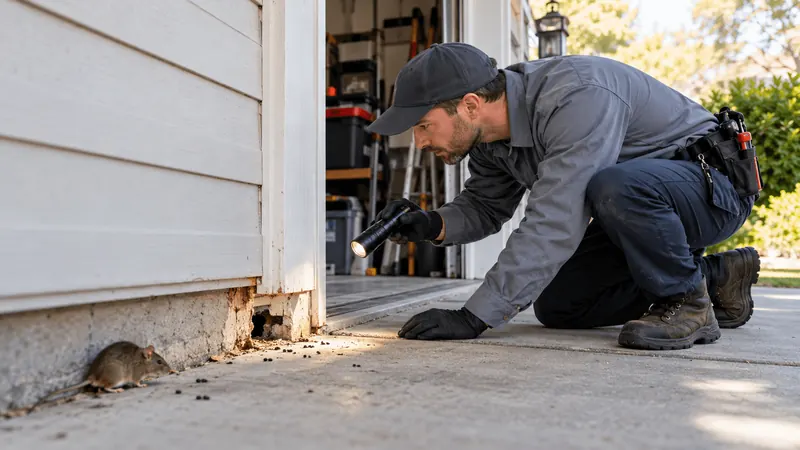
Signs of Rats or Mice in Your Home
- Noise at night. Scratching, scurrying or rolling sounds in the ceiling, attic or upper walls, usually after dark. Roof rats are mostly active at night.
- Droppings. Found in the attic, garage, along walls, in drawers, behind appliances or in the pantry.
- Gnaw marks on food packaging, stored boxes, wood trim, plastic pipes or wire insulation.
- Grease marks along walls, beams and pipes where rodents rub as they travel the same path.
- Half-eaten fruit in the yard, especially citrus, avocados and loquats, hollowed out while still on the tree.
- Nests of shredded insulation, paper or fabric in the attic, garage storage or behind appliances.
- Pets reacting to walls or ceilings, or a musty smell in closed rooms.
Roof Rats, Norway Rats and House Mice
The most common rodent in Oxnard attics is the roof rat, a slim, agile climber that travels along fences, power and cable lines, tree branches and palm fronds, and gets in at the roofline. Norway rats are heavier burrowers that live at ground level, under slabs, in sheds, along drainage channels and around garbage areas. House mice get in at ground level through gaps under garage doors and around pipes and live in kitchens, cabinets and stored items.
The species tells us where to look for entry points: roof rats from above, Norway rats and mice from below.
What Our Rodent Control Service Includes
1. Inspection of the whole building
The technician checks the attic, garage, crawlspace or slab edge, roofline, eaves, gable and foundation vents, roof-to-wall joints, plumbing and AC line penetrations, the dryer vent, garage door seals, and the landscaping touching the house. The goal is to find every gap a rodent can use, plus travel paths and nesting areas.
2. Trapping
Traps are set in the attic, garage and other active areas along travel paths. They are checked and reset on follow-up visits, and trapped rodents are removed.
3. Exclusion (sealing entry points)
This is the step that makes the difference. Gaps are sealed with materials rodents can't chew through, such as galvanized hardware cloth, metal flashing, sheet metal and exclusion mesh. Torn vent screens are replaced, gaps under garage doors are sealed, and gaps at pipe and conduit penetrations are closed.
4. Exterior monitoring where appropriate
On properties with high outdoor rodent pressure, locked tamper-resistant bait stations can be placed outside. We don't put bait inside the attic or living area, to avoid rodents dying in wall voids.
5. Follow-up
Follow-up visits check the traps and exclusion work. When traps stop catching rodents and there's no new activity, the job is done.
What Affects the Cost of Rodent Control
Rodent control cost is driven mostly by how many entry points need sealing and how hard they are to reach. A single-story house with a few gaps under the eaves is a much smaller job than a two-story house with a tile roof, many vents and a large, low attic. Other factors:
- The number of follow-up trapping visits needed
- Tile roofs, where the open ends at the eaves (bird stops) often need to be closed off
- Roof pitch and height, and whether a tall ladder or roof access is needed
- Crawlspace access and vent condition on raised-foundation houses
- Attic contamination that makes insulation removal worth considering
You get a price for the exclusion work after the inspection, so you know the full scope before we start.
When a Rodent Problem Is an Emergency
Call right away, including at night, if:
- A rat or mouse is loose in the living area, bedroom or kitchen
- You find chewed electrical wiring or smell burning plastic, which can be a fire risk. Turn off power to the affected circuit if you can do so safely
- Rodents are in a food business, a kitchen or near a baby's room
- There's a strong decomposition smell from a wall or ceiling
Rodent droppings can carry disease. Don't sweep or vacuum dry droppings; that puts dust in the air. Wet them with a disinfectant first and wear gloves, or leave cleanup for after the visit.
Why Oxnard Has So Many Roof Rats
Oxnard sits on the Oxnard Plain, surrounded by farmland and crossed by drainage channels, with the Santa Clara River on the north edge and the harbors on the coast. That landscape supports large outdoor rodent populations. Inside neighborhoods, mature palms, ivy-covered walls and backyard fruit trees give roof rats food and shelter, and the mild winters mean they breed most of the year. When fields are cleared or harvested, or flooding moves animals out of low areas, rats and mice move into the nearest houses. Homes next to open land, like parts of Riverpark, and waterfront properties around Channel Islands Harbor are especially exposed, so sealing the roofline matters more than trapping alone.
How to Prepare and What to Do Afterward
- Clear a path to the attic hatch and move boxes away from garage walls.
- Pick up fallen fruit and harvest ripe fruit promptly.
- Store pet food and birdseed in metal or heavy plastic containers with tight lids.
- Keep tree branches trimmed back several feet from the roof.
- Don't remove or move traps between visits.
- Let us know right away if you hear new noises after the sealing is done.
Rodent exclusion is one of the most useful services a local Oxnard pest control company can provide, because it keeps working after the visit. Rats in the attic often come with other problems: we frequently find signs of drywood termites in the same space, and rodent entry points also let in spiders, covered on our spider control page.