
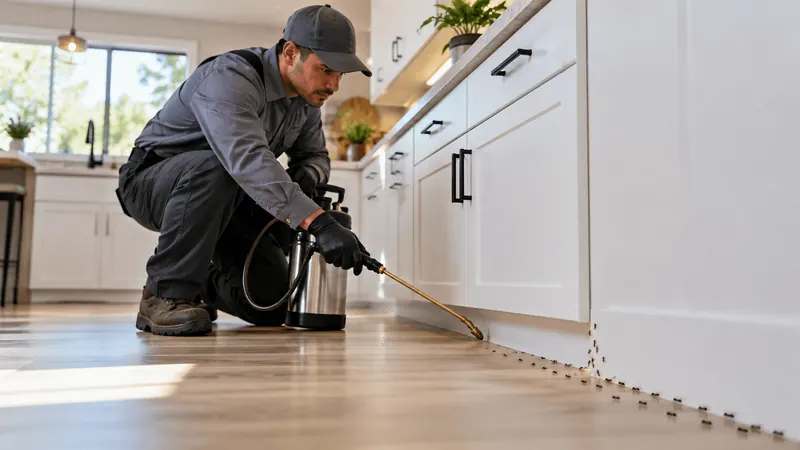
Signs of an Ant Problem That Needs Treatment
A few stray ants aren't worth a service call. These are the situations where store-bought products usually stop working:
- Trails of small brown ants along the backsplash, window frames, baseboards or electrical outlets
- Ants in the dishwasher, pantry, pet food bowls or sugar containers
- Ants in bathrooms and around tubs and sinks during hot, dry weather
- Ants swarming a room right after a rainstorm
- Ants reappearing in a new spot every time you spray the old one
- Ants in beds or tended around plants on a patio, often with aphids or scale
What Causes Ant Invasions in Oxnard
Argentine ants are the main indoor ant along the Southern California coast. They form huge, connected colonies with many queens spread under lawns, mulch, planter beds and concrete. When conditions outside change, big numbers of workers move indoors fast.
- Rain. Oxnard's winter storms flood shallow nests. The ants move up and into walls and rooms.
- Heat and dry spells. In late summer and during Santa Ana winds, ants come inside for water, which is why bathrooms and kitchen sinks see so much activity.
- Food. Crumbs, pet food, fruit, and sweet residue on counters draw scouting ants, which lay chemical trails for the rest.
- Irrigation and landscaping. Sprinkler-watered lawns and mulch next to the foundation give colonies a moist home right against the house.
How Our Ant Control Treatment Works
- Inspection. The technician follows the trails from inside back to where the ants enter the house and then to the nesting areas outside: planters, under slabs, along the foundation, under pavers and in tree trunks with aphids.
- Identification. Argentine, odorous house, ghost, pavement and carpenter ants respond to different baits and products. Getting the species right is the difference between a treatment that works and one that doesn't.
- Indoor baiting. Gel or liquid baits go into cracks, behind outlet covers and along trails. Worker ants carry the bait back to feed queens and young.
- Exterior perimeter treatment. A non-repellent product is applied to the foundation, entry points, door thresholds, window frames and nesting areas. Ants walk through it without noticing and carry it back to the colony.
- Entry point advice. We point out gaps at pipe penetrations, window frames and slab joints worth sealing, and landscaping touching the house that gives ants a bridge in.
For carpenter ants, the job also involves finding the damp or damaged wood they are nesting in, which can overlap with our termite inspection.
What Affects the Price of Ant Control
Ant control cost depends on the species, how many areas of the house are affected, and how large the property is. A single trail in a kitchen is a smaller job than ants in several rooms plus nests all around a large yard. Carpenter ant jobs cost more because the nest has to be found in the structure. Homes with heavy landscaping, multiple patios or large lots take more product and time outside. Because Argentine ants keep reinvading from neighboring yards, many homeowners choose repeat treatments timed before the rainy season and the hot season; we explain the options and costs so you can decide.
When an Ant Problem Needs Fast Service
Most ant problems can be booked for a regular visit. Call sooner if:
- Ants are in a commercial kitchen or food storage area
- Ants are on a bedridden person, an infant's crib or a pet that can't move away
- Ants are swarming around electrical outlets, panels or equipment, which ants can damage
- A child or pet has been stung repeatedly by fire ants or harvester ants
How Oxnard's Rain Pattern Affects Ant Control
Oxnard gets nearly all of its roughly 15 inches of annual rain between about October and April, and almost none from May through September. Argentine ants react to both extremes: when the first big storms saturate the soil, the colonies move up into walls and kitchens, and when the dry season peaks, they go looking for water inside. That's why the same house can have two ant seasons a year. A perimeter treatment applied before the first fall rains and again as the weather dries out holds up better than waiting until the trail is already on the counter.
What You Can Do Before and After Treatment
- Store sugar, cereal, honey and pet food in sealed containers.
- Pick up pet food bowls between meals for a few days.
- Don't spray over bait placements or clean the treated baseboards with strong cleaners for about a week.
- Keep mulch, bark and dense ground cover a few inches away from the foundation.
- Trim tree and shrub branches that touch the roof or walls.
- Fix leaking hose bibs and sprinklers that soak the foundation.
Ant control is one of the most common calls we get as an Oxnard pest control company. If you are seeing cockroaches in the same kitchen, our cockroach treatment uses a similar crack-and-crevice approach and can be combined with the visit.